

In short: IFRS 18 replaces IAS 1 for annual periods beginning on or after 1 January 2027. The new accounting standard sorts every item of income and expenditure into one of five categories, makes every company show two new subtotals (operating profit, and profit before financing and income taxes), and brings companies’ own “adjusted” measures into an audited note. More importantly, IFRS 18 will only change how results are presented, not how the numbers themselves are measured.
Background
Pick two listed companies in the same industry and look for their operating profit. Good luck finding a consistent presentation. You may well find the term on both income statements, and yet the two figures may not be built the same way. One company might include its share of profit from a joint venture; the other might leave it out. One might count interest earned on its cash; the other might not.
That has been possible because IAS 1, the standard that has governed how financial statements are presented, never defined operating profit. When the International Accounting Standards Board (IASB) looked at 100 companies, it found that over 60 reported an operating profit figure, and that they used at least nine different ways to calculate it.
For an investor, that is a real problem. A ratio such as operating margin is only useful if the operating profit behind it means the same thing from one company to the next. IFRS 18 is the IASB’s answer: the biggest change to how companies present their financial performance in more than 20 years, in the IASB’s own description.
If you are new to the income statement, our guide How to Read Financial Statements: A Beginner’s Guide is a good place to start before reading on.
What IFRS 18 is
IFRS 18 Presentation and Disclosure in Financial Statements was issued by the IASB on 9 April 2024. It replaces IAS 1 and applies to annual reporting periods beginning on or after 1 January 2027. Companies may apply it earlier.
Much of IAS 1 carries over unchanged. The new requirements focus on three areas: the structure of the income statement (the standard calls it the statement of profit or loss), the disclosure of companies’ own performance measures, and how items are grouped and labelled.
One point is worth stating clearly. IFRS 18 does not change how companies recognise and measure items. Revenue is the same, costs are the same, and profit for the year is the same. What changes is where items sit on the page and which subtotals appear.
Five categories for every line
Under IFRS 18, every item of income and expenditure is classified into one of five categories: operating, investing, financing, income taxes and discontinued operations. The first three are the ones that need explaining.
Operating
The operating category is the default. It holds all income and expenditure items from a company’s operations, including items that are volatile or unusual. A one-off restructuring cost, for example, still belongs in operating. Anything that does not belong in another category ends up here.
Investing
The investing category holds income and expenses from assets that generate a return largely on their own, independently of the company’s other resources. Examples include rental income from investment property, interest earned on cash and debt securities, dividends from shares the company holds, and its share of the profits of associates and joint ventures.
Financing
The financing category holds income and expenses from liabilities that involve only the raising of finance, such as interest on a bank loan. It also takes the interest on some other liabilities, such as lease liabilities and defined benefit pension liabilities.
Banks and insurers
For some companies, investing or financing is the main business. A bank makes its money from lending operations, and an insurer makes its money from investing the premiums it collects. These companies will include some income and expenditure items in operating profit that, for other companies, would sit in investing or financing. That’s the only way to make their operating profit numbers reflect a fair picture of what they actually do.
Two new subtotals
The categories produce two subtotals that every company must now present:
Operating profit: all income and expenses in the operating category.
Profit before financing and income taxes: operating profit plus the investing category.
Operating profit becomes a defined number for the first time. A company can no longer choose what goes into it, because the standard sets that. So when you compare the operating margins of two IFRS companies, you will be comparing like with like far more often than before.
The second subtotal shows the profit made by the business and its investments before the cost of borrowing. That makes companies with very different amounts of debt easier to compare. The same thinking, separating the business from the way it is financed, sits behind enterprise value, which we explain in Enterprise Value vs Equity Value: The Bridge Explained.
Management-defined performance measures (MPMs)
Many companies also report their own metrics, such as adjusted operating profit or adjusted EBITDA, in results announcements and investor presentations. These are often the numbers that analysts and headlines focus on. The IASB found that investors find them useful, but have concerns about how transparently they are calculated.
IFRS 18 calls these management-defined performance measures, or MPMs. They are subtotals of income and expenditure that IFRS does not specify, yet are used in public communications outside the financial statements to give management’s view of performance. Companies can keep using them, but must now disclose them in a single note to the financial statements, with:
a reconciliation to the most similar subtotal defined by IFRS;
an explanation of why the measure is reported and how it is calculated;
the income tax effect of each adjustment in the reconciliation.
Because the note sits inside the financial statements, it is covered by the audit. Carlsberg’s reconciliation, which we look at below, is a good example: it starts from IFRS operating profit, lists each adjustment, and shows the tax effect of each one.
Clearer grouping and labels
IFRS 18 adds principles for when items should be combined (aggregation) and when they should be shown separately (disaggregation). Items with shared characteristics are grouped together; items that differ in a way that matters are split out, and a single important difference can be enough.
The label “other” gets particular attention. Companies should use it only when they cannot find a more informative label, and should then label as precisely as possible, for example “other operating expenses”. Large unexplained “other” lines should become less common.
Companies can still present operating expenses by function (cost of sales, distribution, administration), by nature (staff costs, depreciation), or a mix of the two. In addition, a note must show how much depreciation, amortisation, employee benefits and impairment of non-financial assets is included in each line of the operating category. For a company that presents its costs by function, that brings out figures that would otherwise be hidden inside cost of sales or administrative expenses.
Changes to the cash flow statement
IFRS 18 comes with amendments to IAS 7, the standard for the cash flow statement. The two most important of those amendments are:
A common starting point. Under the indirect method, cash flows from operating activities now start from operating profit.
Less choice over interest and dividends. For companies whose main business is not investing or finance, interest and dividends received go in investing activities, and interest and dividends paid go in financing activities. Banks and insurers follow different rules.
Previously, companies could choose where to show interest and dividends, which made cash flow from operations harder to compare. Removing that choice for most companies fixes one of the most common differences between cash flow statements.
What it looks like in practice
Most companies will wait for the 2027 start date. Airbus, for example, says in its 2025 financial statements that early adoption is not planned, and its 2026 results are still prepared under IAS 1. A few companies have moved early, and their reports show the new layout with real numbers.
Carlsberg (Denmark)
The brewer Carlsberg adopted IFRS 18 with effect from 1 January 2026. Its first report on the new basis was its half-year statement for the six months to 30 June 2026, published on 19 August 2026, with the 2025 comparatives restated.
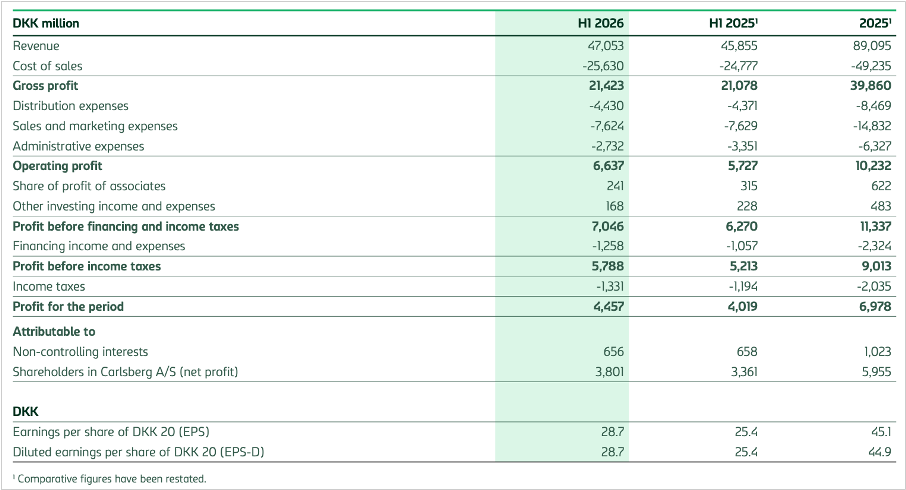
Carlsberg income statement, H1 2026 (DKK million; negatives shown with a minus sign, as printed). Source: Carlsberg Group H1 2026 Financial Statement, company announcement 9/2026, 19 August 2026, page 16.
Both new subtotals are there: operating profit of DKK 6,637m and profit before financing and income taxes of DKK 7,046m. Between them sit Carlsberg’s share of profit of associates (DKK 241m) and other investing income and expenses (DKK 168m). Associates are investing items under IFRS 18, so they now sit below operating profit rather than inside it.
Carlsberg also shows how its own adjusted figures fit with the new rules. Its preferred measure, operating profit (CPM), adds the associates back, together with adjustments such as restructuring and integration costs. Under IFRS 18 that reconciliation now sits in a note to the financial statements:
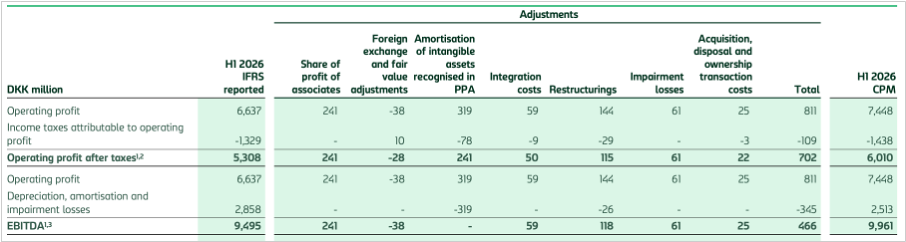
Carlsberg reconciliation of its management-defined performance measures, H1 2026 (DKK million). Source: Carlsberg Group H1 2026 Financial Statement, page 21.
Read across the first row: IFRS operating profit of DKK 6,637m plus DKK 811m of adjustments gives operating profit (CPM) of DKK 7,448m. Management says it includes the associates because they reflect the contribution of its strategic investments. Whether or not you agree with that choice, you can now see exactly what was added back, and why.
Chorus (New Zealand)
Chorus, the New Zealand telecoms network company, early adopted NZ IFRS 18, New Zealand’s version of the standard, for its year ended 30 June 2026. Its income statement shows operating profit of NZ$287m and profit before financing and income tax of NZ$290m.
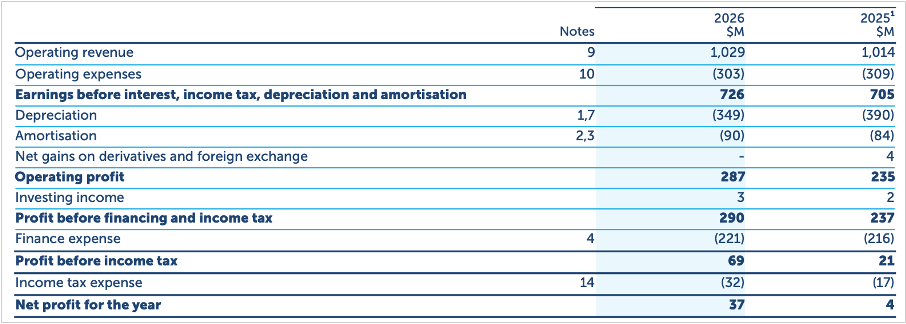
Chorus consolidated income statement, year ended 30 June 2026 (NZ$ million). Source: Chorus FY26 Annual Report, page 41.
Chorus’s report is especially useful because it shows the restatement line by line. For the year to 30 June 2025, operating profit was NZ$231m as originally reported and NZ$235m restated under IFRS 18:
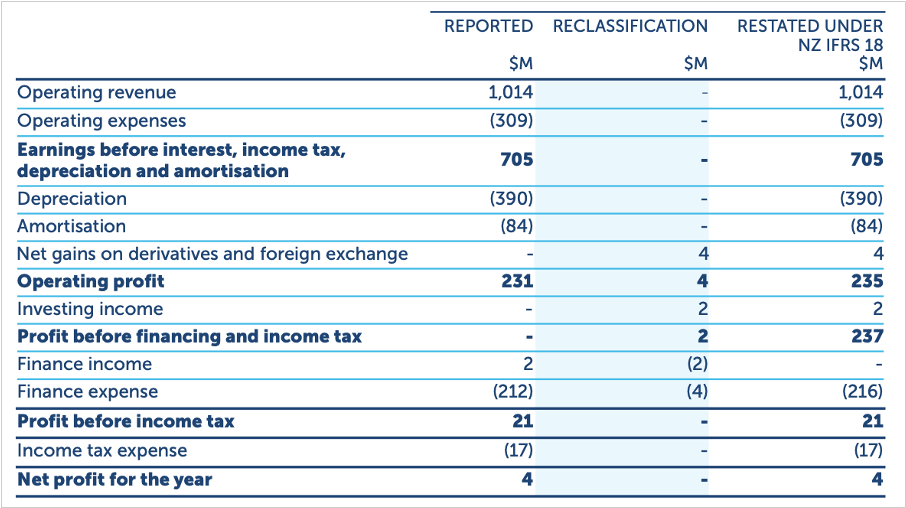
Chorus reconciliation of the restated income statement for the year ended 30 June 2025 (NZ$ million). Source: Chorus FY26 Annual Report, page 49.
The NZ$4m difference comes from net gains on derivatives and foreign exchange, which used to be netted within finance expense and now sit in operating profit. Finance income of NZ$2m moved to investing income. Net profit for the year is NZ$4m either way. In Chorus’s own words, the adoption “affects presentation and disclosure only”.
Who is affected, and when
IFRS 18 applies to companies that report under IFRS Accounting Standards. In the UK, the UK Endorsement Board adopted it for use on 10 December 2025. The European Union endorsed it on 13 February 2026, with the same start date: annual periods beginning on or after 1 January 2027.
The standard applies retrospectively, so comparative figures are restated too. A company with a December year end will first report under IFRS 18 for the year ending 31 December 2027, and the 2026 figures shown next to them will be on the new basis. It also applies to interim financial statements, so the new layout is likely to appear first in half-year reports during 2027.
The takeaway
For anyone learning to read accounts, IFRS 18 makes the income statement easier to compare. When you see operating profit in an IFRS annual report from 2027 onwards, you will know broadly what is in it. When a company leads with its own adjusted figure, you will find a reconciliation in the notes showing exactly what was taken out, and why.
It is still worth reading the notes. Companies keep some judgement over how items are grouped, and a defined subtotal is only as useful as your understanding of what sits inside it. But the starting point will now be the same for every IFRS company, and that is a real step forward for comparability.
FAQ
Does IFRS 18 change a company’s profit?
No. It changes presentation and disclosure, not recognition or measurement, so profit for the year is unchanged. Operating profit may differ from the figure a company reported before, because it is now defined by the standard.
When does it start?
For annual reporting periods beginning on or after 1 January 2027, with the comparative year restated. Companies may apply it earlier.
Can companies still report adjusted profit?
Yes. If an adjusted measure is a subtotal of income and expenditure used in public communications, it becomes a management-defined performance measure (MPM) and must be explained and reconciled in an audited note.
Does it apply to US companies?
Not to companies that report under US GAAP. IFRS 18 applies to companies reporting under IFRS Accounting Standards.
Build the statements yourself
Want to see how the income statement, balance sheet and cash flow statement link together in practice? Our 3 Statement Modelling course takes you through it step by step. Enrol and start today.
Sources
Airbus SE, “Financial Statements 2025”, note 6: early adoption of new standards not planned. https://www.airbus.com/en/investors/financial-results-annual-reports (accessed 25 Nov 2026); and “Airbus reports Half-Year (H1) 2026 results”, 29 July 2026: prepared under legacy standards (primarily IAS 1), IFRS 18 not early adopted. https://www.airbus.com/en/newsroom/press-releases/2026-07-airbus-reports-half-year-h1-2026-results (accessed 25 Nov 2026)
BDO, “The European Union endorses IFRS 18”, 20 February 2026: EU endorsement on 13 February 2026, effective for periods beginning on or after 1 January 2027. https://www.bdo.global/en-gb/news/ifrs-news/the-european-union-endorses-ifrs-18-presentation-and-disclosure-in-financial-statements (accessed 25 Nov 2026)
Carlsberg Group, “H1 2026 Financial Statement”, company announcement 9/2026, 19 August 2026: adoption of IFRS 18 from 1 January 2026 (page 11), income statement (page 16), management-defined performance measures and reconciliation (page 21). https://www.carlsberggroup.com/media/rwuec0en/09_19082026_financial-statement-as-at-30-june-2026.pdf (accessed 25 Nov 2026)
Chorus Limited, “FY26 Annual Report” (including audited financial statements), NZX announcement, 24 August 2026: early adoption of NZ IFRS 18, consolidated income statement (page 41), reconciliation of the restated 2025 income statement (page 49). https://api.nzx.com/public/announcement/478352/attachment/475174/478352-475174.pdf (accessed 25 Nov 2026)
IASB press release, “New IFRS Accounting Standard will aid investor analysis of companies’ financial performance”, 9 April 2024: issue date; study of 100 companies (over 60 reported operating profit, at least nine ways to calculate it); most significant change in more than 20 years; MPMs subject to audit. https://www.ifrs.org/news-and-events/news/2024/04/new-ifrs-accounting-standard-will-aid-investor-analysis-of-companies-financial-performance/ (accessed 25 Nov 2026)
IFRS Foundation, “IFRS 18 Presentation and Disclosure in Financial Statements” (standard page): issue, effective date, early application, replaces IAS 1, comparatives, the two subtotals, MPM definition. https://www.ifrs.org/issued-standards/list-of-standards/ifrs-18-presentation-and-disclosure-in-financial-statements/ (accessed 25 Nov 2026)
IFRS Foundation, IFRS 18 webinar slides, “Grouping of information” (2024): aggregation and disaggregation, the “other” label, by-nature note, IAS 7 amendments. https://ifrs.org/content/dam/ifrs/supporting-implementation/ifrs-18/grouping-slides.pdf (accessed 25 Nov 2026)
• IFRS Foundation, IFRS 18 webinar slides, “Management-defined performance measures” (2024): MPM definition, single-note disclosures, tax effects, investor concerns. https://ifrs.org/content/dam/ifrs/supporting-implementation/ifrs-18/mpm-webinar-slides.pdf (accessed 25 Nov 2026)
• IFRS Foundation, IFRS 18 webinar slides, “Subtotals and categories” (May–June 2024): the five categories, what goes in operating, investing and financing, banks and insurers, retrospective and interim application. https://ifrs.org/content/dam/ifrs/supporting-implementation/ifrs-18/subtotals-and-categories-webinar-slides.pdf (accessed 25 Nov 2026)
• UK Endorsement Board, “UKEB adopts IFRS 18 Presentation and Disclosure in Financial Statements”, 12 December 2025: adopted for use in the UK on 10 December 2025; no change to recognition and measurement. https://www.endorsement-board.uk/news-events/news/ukeb-adopts-ifrs-18-presentation-and-disclosure-in-financial-statements/ (accessed 25 Nov 2026)